
lines and clouds (2)
Chiyoko Szlavnics' Oracles I-V (2019-2020)

Dear reader, mon mignon,
Good to meet here again, right?
[ . . . ]
ooooooooooh, I know, I know darling, you’re upset, it’s been a while, I let you there, waiting for the second part of our series dedicated to Chiyoko Szlavnics’ music. Not fair. Please excuse me: your humble writer has been riding intense musical waves and literal motions—assisting others, moving places, taking a risky yet meaningful spin on the wheel of fame, fortune, and beauty, as my lovely tarot reader wisely pointed out.
[ . . . ]
ooooh, please don’t cry, cutie: you are my favorite reader. Only with you do I share my most precious musical discoveries: these few grains of sand and sounds that open worlds for us, if only briefly, in our fleeting human lives.
[ . . . ]
oh, you missed ep. 1? That’s okay, you can quietly catch up with the link below. I’ll wait for you here with our second and final episode of this season. Please remember to gently blow your nose as well—your humble writer’s misophonia makes it hard to tolerate the sound of running mucus. Thank you.

[ . . . ]
[ . . . ]
1-2, 1-2, are we all here? Are those who cannot tolerate our hot niche of cringe and lunacy gone? Awesome, it was about time. We may therefore Begin. [NB: those wishing to strictly read about music, do feel free to skip the 6 next § ]
A general question that emerged for me when I reopened my reflections on Chiyoko’s work was: how does a grrrl who writes music takes space today—literally/musically, and figuratively. Old fashioned you may say, especially as the binary boooï/grrrl doesn’t exist below the surface, gender is fluid and endlessly playful, one can feel female, male, nb, and/or like an angel one day and a human pup the next; the ultimate goal being to surrender identification with the surface (/form) altogether.1 True, true, ôô so true. Yet, what is equally true is that a somewhat rigid surface exists as well. It is the very ground on which we walk 99,9% of the time, and it is wildly humbling. At least, it is to me.
First, as a former addict to Patriarchal-heteronormative BS and whose path to recovery and sobriety feels embarrassingly slow, each phase of life is evidently accompanied with new lessons to be learned, often looking like crashing planes and burning houses, needing to be metabolized faster than my body and heart can handle. In other words, as much as I naively hoped and prayed that most of those stuff were behind us, well, not really — the fire keeps burning and too often winning.
Second, the older I get, the more I get what this ‘being a grrrl’ means. Actually: I don’t get it intellectually, but I feel it somatically more, and more. For instance, I feel ‘being a grrrl’ when softness spreads in my chest as I gaze at mothers, sensing one glimpse of the timelessness of motherhood and its absurdly heroic demands. I also feel ‘being a grrrl’ when my guts tightens in respond to those words from 1928: “Sir, a woman’s composing is like a dog’s walking on his hind legs. It is not done well, but you are surprised to find it done at all.”2 I feel ‘being a grrrl’ when needing to read out loud Anne Carson’s flambloyant Gender of Sound.
Motherhood, 1928 and Anne Carson are the ground that lives with/in us today—as much as our 2026 progressive desires, our well-intended equal gender and diversity-prone policies, our woke politeness and non-violent modes of communication. Motherhood, 1928 and Anne Carson surface in the exchange of glances between certain grrrls whose eyes carry “I know, and I know you know” or this “I know, and I know you don’t know, yet”. They persist in the banal, or in the “highest sphere of the arts” in more or less concealed ways, with a sticky pattern: grrrls may be cautiously (/intermittently?) seen and supported, as long as it doesn’t disrupt the expectations for them to remain a lil weaker, a lil quieter, a lil convenient-er—content and contained.
And yet, the highest, most refined form of embodied grrrl-ity may be an unbitter, loud openness: a discerning brilliance and even a destructive power that threatens surface and form. In the same way, the highest form of embodied boooï-ity may be a grace that shines endlessly, steadily, and gently through surface and form. We need both, equally, within ourselves and in others. Not reinventing the wheel, but reactivating the engine, just like Adrian Piper’s3 [roaring] motto4:
“You can drive the grrrl out of philosophy,
but you can’t drive philosophy out of the grrrl.
;D “
If there’s a grrrl you can’t drive music out of, it is certainly Chiyoko. Today, we’ll look into her incredible Oracles I-V (listening spaces) from 2019-2020 and composed for Ensemble Contrechamps. In her words, an Oracle is a reminder of being human, of single, lonely voices in a vast space or cosmos. The title couldn’t fit this astonishing piece better, which was recently released on Neu Record. Amazingly, Chiyoko has agreed to generously share with us some exclusive excerpts of the score. This your lucky day, dear reader, so do enjoy every bit of it.
As usual, I’ll successively present macro, meso, micro perspectives on the piece, and inject the stupid stuff here and there [ i kno some of you only read those posts for the stupid stuff]. So much to say, so much space to take: let’s go grrrl ;D
macro: c’est le cas de le dire
Oracles I-V’s approach to composition and sound is very different from Gradients of Detail’s. Although both pieces drawing from a rigorous Just intonation pitch space and Chiyoko’s idiosyncratic sense of restraint, sparseness and suspended time, Oracles focuses less on an highly detailed perception of harmonic relationships. Instead, it operates on much wider perceptual, temporal and musical scales, resulting from Chiyoko’s 2-year, intense study of the acoustics of the gigantic space where the piece was initially premiered, in radical interdependence with the piece’s instrumentation. Let’s listen together first to the initial recording of the piece—which I’ve listened to at least 100 times, especially during lockdown. Enjoy.
One Giant Space: Bellelay Abbey
The piece was composed composed in 2019-2020, and premiered in the mega Bellelay Abbey in the Swiss Jura in 2020.5 The video doesn’t transpire the enormity of the space, but you might better imagine its dimensions and acoustics by looking at the photo below:
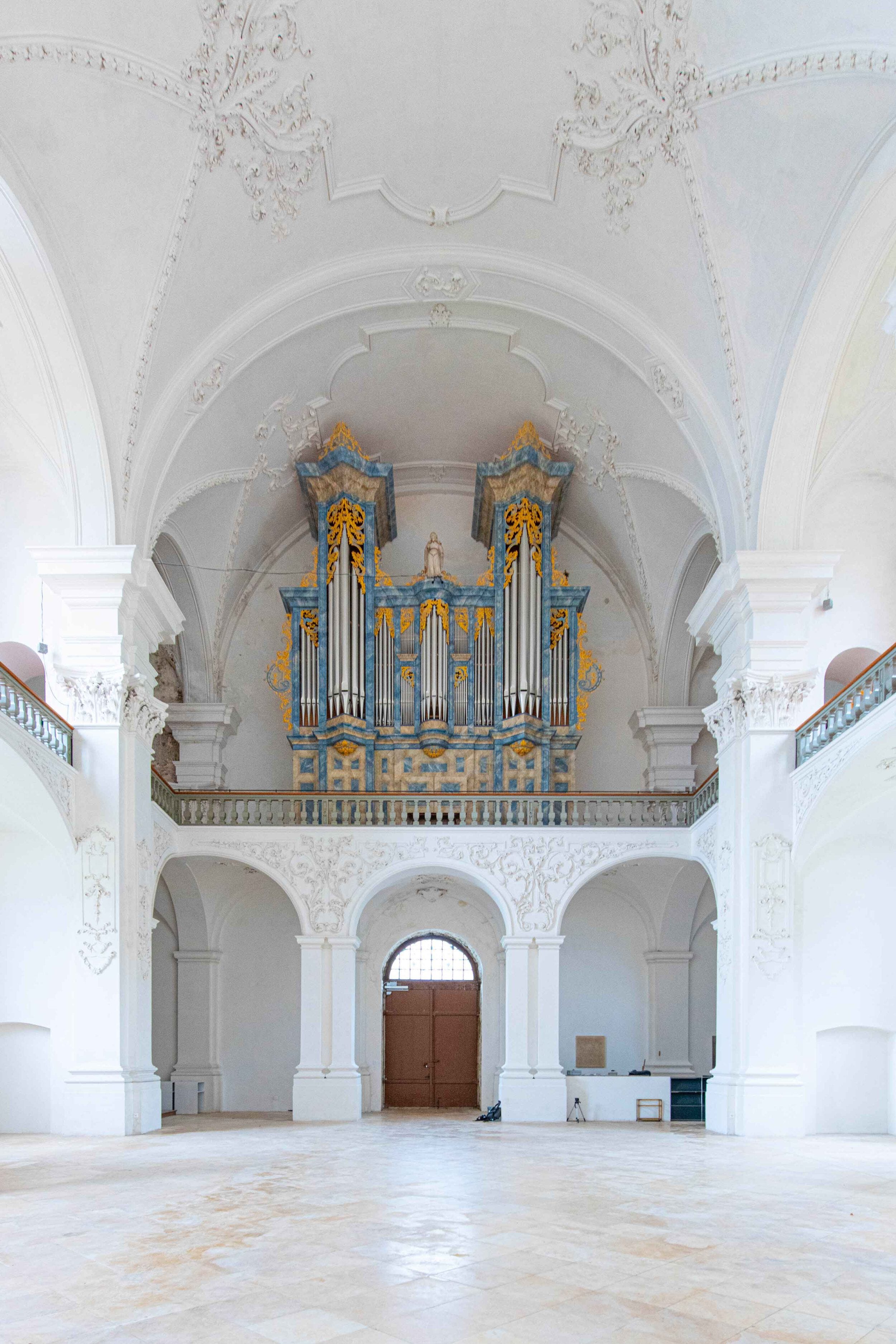
Founded around 1140 by the Premonstratensian Order and rebuilt in the 18th century, Bellelay Abbey is a Baroque jewel, with its abbey church designed by Austrian architect Franz Beer and conventual buildings dating from 1736. Post brutal French Revolution, the church was desacralized and the site fell into decline, housing various industries and later a psychiatric clinic (!). Restored in the late 1950s, the former abbey church has since become a major cultural venue, presenting visual art and sound installations, along with an outstanding concert series launched in 2020.
foundation existed for a longer time, but the specific concert series has been running since 2020, so not exactly "taken over the place"? There have also been visual art and sound installations since before 2020, not sure of the exact year it all began...
Such large abbeys (and cathedrals) carry very specific sound behavior: loooong reverb time due to huge interior volumes and stone surfaces—sound energy bouncing in space instead of being damped. Due to the heights of the ceilings and vaults and arches, sound seems to come from everywhere and diffused, high frequencies mostly decaying faster than low and mid frequencies. In some abbeys, there additional acoustic lenses or mirrors, concentrating sound energy into specific spots—like columns and vaults. Such acoustic ‘hotspots’ can make sound supernaturally loud in one place, and quiet just a few steps away. No doubt the Bellelay Abbey has such acoustic supernatural characteristics, carefully studied by Chiyoko. Indeed, the Bellelay Abbey’s space and architecture inspired Chiyoko, wishing the “experience of sound in the abbey’s resonant, enormous interior” to be at the center of Oracles I-V.
20 Grands Musicians
The piece Oracles was composed for 20 of the very profesh Ensemble Contrechamps musicians: C Flute/Bass Flute, Oboe, 2 Bb Clarinets/ Bass Clarinet, 2 Trumpets, 2 Horns, Tuba in F, 4 Violins, 2 Violas, 2 Violoncelli, 1 Contrabass, 2 Percussion (including vibrophones, bass drums, brass triangles, bowed crotales).6
Naturally, the sounds of these instruments carry distinct directional qualities and spatial impacts. The horn and trumpet project outward and can easily dominate in volume; the clarinet and oboe are more discreet and localized; the flute even more so (except in its highest register), often fusing with other instruments. The bass drum has a diffusive presence, operating “beneath” the ensemble whether played softly or loudly. Bowed crotales cut through and seem to hover above the texture, though without sharply defined directionality. The strings are comparatively mild—gently localizable, gently directional, gently resonant. Gentilles strings.
This interplay of timbral and spatial qualities is very much at work in Oracles.
20 Musicians + 1 Bellelay Abbaye= 5 Stellar Oracles
In Chiyoko’s score, one reads: “The musicians’ positioning for each Oracle is central to how the instruments’ timbres and their resonance within the abbey will be experienced by the audience. Their positioning is also essential to how the movement of sound in the large space has been composed in the score.” There is much to unpack in these crucial opening lines.
First, they underscore the site-specific nature of the piece. Oracles I–V was composed for and with the space in mind, carefully considering both the abbey’s acoustics and the timbral qualities of the instruments. Detailed stage plans specify the musicians’ placement, and these positions are not static. They shift from one section to the next, reinforcing the choreographic dimension of the work. Perhaps one even more salient aspect of the piece is that it sculpts trajectories of sound—lines, curves, circles— passing between instruments, combined with a refined control of texture, timbral masking and harmonic fusion.
Another radical aspect lies in the use of the ensemble itself. Some sections involve all 20 musicians; others reduce the forces to as few as four players. This contrast amplifies extremes: the cosmic (full ensemble filling the vast space) and the intimate (a single voice resonating within it). In the same way, the resonant and hugely reverberant qualities of the Abbey are structural to the piece and its silences. Of course, such a space presents challenges — precise tuning becomes difficult, even unisons can blur. For this reason, Chiyoko explained that she intentionally kept the harmonic material relatively ‘simple’ (up to 7-limit intervals) avoiding more complex dissonances (such 11- and 13-limit intervals). This preserves the clarity of rationally related pitches, allowing them to fuse and move dynamically in direct interaction with the acoustics of the space.
Listening to Oracles I–V, then, means attending to large-scale forms and to sound traveling through architecture. To my knowledge, it is one of the rare works that so thoroughly composes spatial motion while remaining deeply informed by just intonation principles.
[ dear reader, if dis ce que makes sense to you— or if its nonsense makes you smile— consider subscribing, sharing, becoming a regular paid subscriber, or making a one-time contribution. the other day, a friend told me that dis ce que felt so smooth to read (v kind) that she imagined i must be drafting the posts in a single evening. i’ll take that as a compliment. what it means is that care, doubt, rereading 10x are distilled until they appear effortless here. so, if this space nourishes you, helps you think, or simply keeps you company, you’re warmly invited to help it grow ]
meso: brief part-by-part presentation & JI considerations
Oracles I–V presents a wide range of musical materials, aesthetics, and references. This diversity reflects Chiyoko’s spatial explorations of the Abbey, as well as aspects of her musical education, collaborations, and friendships; almost like distinct life “chapters,” or an audible mapping of lineages. I’ll briefly introduce each Oracle with short excerpts, partly drawing on Marc Sabat’s excellent liner notes, in the hope of convincing you to purchase the full release. Last but not least, I highly recommend listening to the piece with a good pair of headphones and/or quality speakers.
Oracle I
Oracle I is certainly the most ‘spectral’ of the 5 Oracles. Loosely extrapolating from Chiyoko’s own impressions, one might describe its gradual thickening of the full ensemble as oceanic; or like a sun rising from the darkest night, slowly filling the vast space of the Abbey. The sound emerges from the depths of horns and tuba, joined by the lower strings, grounding the harmony around B♭, F, C, and G. Above this foundation, a C–E drone unfolds, later expanded by the addition of D and A — tones foreshadowed earlier through the appearance of their 5-limit counterparts.7
Oracle II
As Marc Sabat notes, “Oracle II features a spatial and density shift to a circle of strings playing unison G evoking the experience of combination tones by adding harmonics and brief phrases of glissandi. Here one senses echoes of Szlavnics’ earlier music with sliding tones, informed beautifully by her experiences as a singer and student of Dhrupad.” One might also be reminded of Gradients of Detail, yet the distinctiveness of Oracle II lies in the way sound circulates physically through the ring of strings. This spatial choreography creates a subtly hypnotic effect, especially when one listens closely to the minute pitch inflections and the shifting distribution of sound from instrument to instrument. Give it a try:
Oracle III:
Taking the reduction of the ensemble a radical step further, Oracle III is the most minimalist of the five sections. It serves as an homage to Marc Sabat’s 1996 piece For Michael Baker, itself a beautiful work.
Oracle III unfolds as a dialogue between two bass drums; placed at opposite ends of the Abbey, and two trumpets positioned high above, also at extreme ends, each repeating the same D6. Unison aside, more complex tuning is entirely absent. Instead, the section centres on continuity: the cloudy resonance of softly rolling bass drums and the piercing D6 of the trumpets traveling through space, adding a C♯6 later as well. Their presence becomes even more palpable in moments of near-silence. Simply beautiful. Slightly mysterious, slightly cosmic, slightly “the infinite is an instant”8 — and preparing the ear for a shift in listening as the concluding sections unfold.
Oracle IV and V
To me, Oracles IV and V have always felt like a turning point in the work as a whole. So we’ll delve deeper into them in a minute. While continuing and synthesizing elements of the earlier sections, they bring Chiyoko’s idiosyncratic, diamond-sharp voice more clearly to the foreground. My own listening shifts here as well, operating from and on the heart. There, I said it. It is like the sensuous shaping and reshaping of material, the gentle turning around something, lightly touching it, yet with such depth of emotion, softness, and intensity in that touch. One simply has to ride the softness without holding back.
The motif from Oracle III flows into Oracle IV, before gradually thinning toward its most minimal reduction in Oracle V—mainly centering on C♯ and D, as well as a high B and G♯ in the strings and clarinets.
The motif from Oracle III carries into Oracle IV, then gradually thins to its most reduced form in Oracle V—largely focused on C♯ and D, with a high B and G♯ in the strings and clarinets acting (in my opinion) as brief points of release or “breathers”. At the same time, Oracle V is the most dynamic and unstable section, owing to its more open notation and sustained tones of 2-3 seconds, combined with the introduction of five triangles. Percussion, winds, and strings occupy only the higher registers; the basses are entirely absent. The result is a continuous shimmer, like distant shooting stars.
The weaving of instrumental roles is beautifully handled, restoring balance between strings and winds, both equally active, with crucial percussive punctuations. The steady pacing of the five triangles, playing fast rolls within the high, luminous texture, seems to accentuate the beating produced by the simultaneous C♯ and D. For me, the triangles function almost literally as an amplification of those interference patterns. Remarkably clever of Chiyoko.
Honestly, I could (and have) listened to this section endlessly. The way the sound falls away at the end, with care yet a quiet, simple detachment, is just astounding.
micro: zooming in Oracle IV
Let’s delve into Oracle IV. Lucky you dear reader, the section is “freely/fully” available on Bandcamp [ But do buy the entire release, you won’t regret it. ]
Interesting aside: Chiyoko mentioned that the recording had to take place at night to avoid traffic noise. The strings could not be arranged in a circle, and the instruments had to be positioned closer to the microphones to allow for more fluid mixing afterward. In other words, the spatial experience on the CD differs significantly from that in the Abbey—an experience one might approach more closely through the YouTube video documentation. In that sense, I fully agree with Marc Sabat’s perspective on how the recording “documents” the piece more than anything else. These processes of translation, from space to recording, raise compelling questions that I won’t pursue here. Instead, let us turn to Oracle IV’s score in its original, spatial feature.
Instrumentation & spatial configuration
Overall, the acoustic balance in Oracles is shaped by unusual lines of opposition between pairs of instruments, with different families occupying distinct regions of the Abbey.
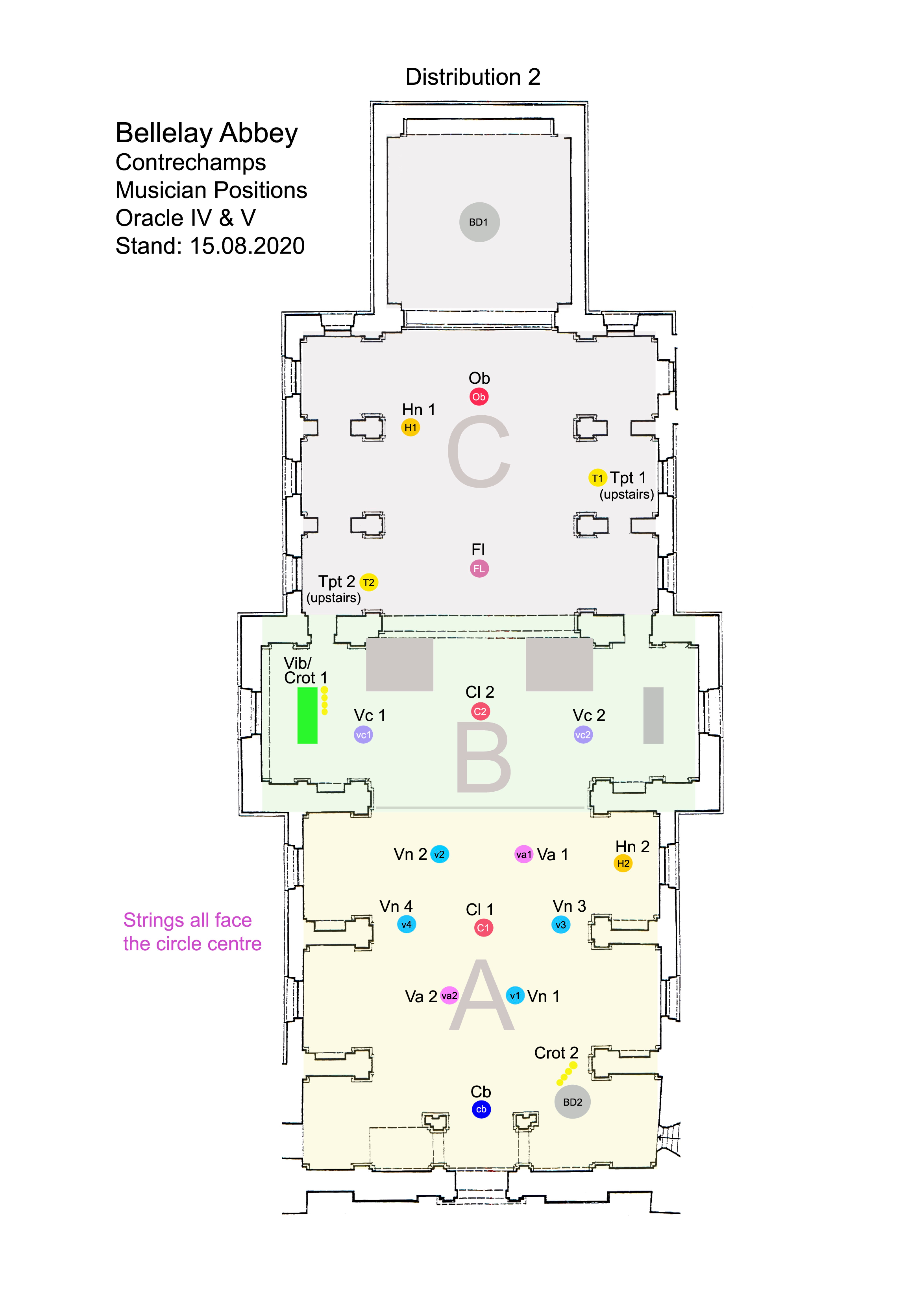
Strings are positioned in regions A and B, while brass and winds primarily occupy region C, with a few players interspersed in A and B. Percussion is distributed across A, B, and C, including one bass drum placed in the apse—the rounded end behind the altar, which acts as a natural sound projector. This placement boosts clergy voices and choir sound into the nave, functioning like a giant parabolic shell to carry unamplified sound across the space. Another bass drum is positioned at the back right, between two reflective columns and the back wall, producing longer delays. This is counterbalanced by crotales in the middle section, on the left, beneath a vault and near side walls, creating early reflections.
Cellos face each other in the middle of the Abbey, placed under respective vaults and next to large stone columns that act as secondary reflectors, adding localized coloration. Trumpets are located upstairs, taking advantage of upward projection and later reflections from the highest points of the vaults. Horns are positioned near reflective columns, naturally projecting sound toward the right side and rear. A circle of strings occupies the back section of the Abbey, while lines between oboe and double bass, and between flute and two clarinets, stretch across the entire space without proximity to reflective columns, covering the full distance from back to near the front of the Abbey.
Melodic-harmonic material as spatial ‘diffusion’ / JI considerations
0’00'-2’30”: building up
Continuing from the D-motif of Oracle III, the piece begins with a unison around the region of E.9 The latter forms the basis of a musical motif I’ll call the Call Mi. Don’t ask me why, it’s just catch-E. Let’s listen to it and have a brief look at its 3-part, contrasting morphology.
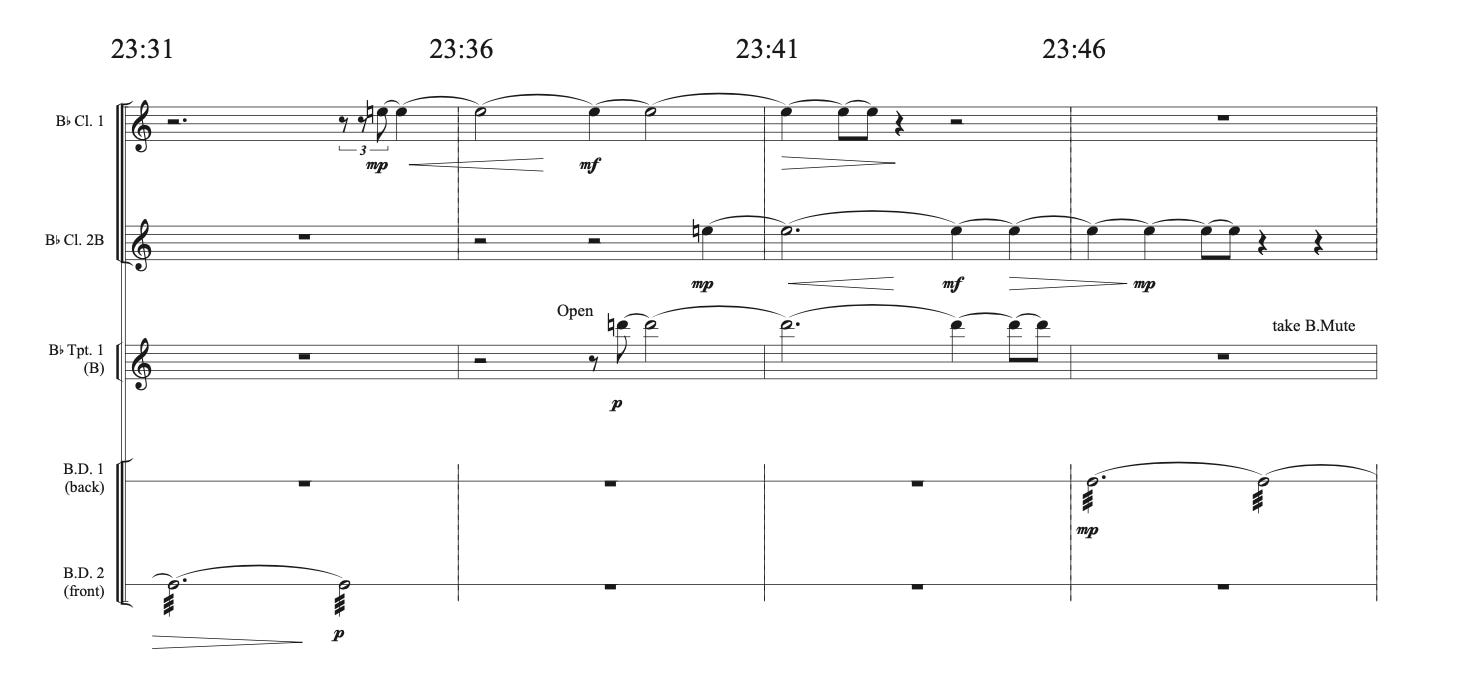
The Call Mi goes as follow:
a blurry line on the bass drums, like a low, soft cloud, distantly introduced through crescendo and decrescendo, sometimes from complete silence, sometimes introducing the Call Mi musical cell and sometimes ending that cell.
piercing tone from the winds, like rays of light, with an assertive attack (one may read ‘bring out’ one some of the winds parts in the score) and gradual fade out,
followed by an overlapping, more diffused, in-between echo or answer by the strings—like added reflections on water, introduced through a soft crescendo and decrescendo.
Once the Call Mi has been complete, a cloud passes on the drums, sometimes with a short silence, before the winds’ high tones attack. Note that within each family of instruments, the material each instrument plays is treated a little bit interchangeably in terms of pitches, who starts or ends each part of the Call Mi. This is especially noticeable between the Flute, Oboe and Trumpets, how they play alternatively the E5, different versions of D, G or A, although consistently in harmonic fusion with the E.
What is especially fascinating in the opening minutes of the piece is how, with each repetition of the Call Mi, instruments and tones are non-linearly added, carefully extending and enriching the texture, expanding the palette, and carving ascending melodic motions. For example, around 0’41–1’20 in the recording: the unison on E5 begins in mf on B♭ Clarinet 2 and Flute, cushioned by the emergence of a soft cloud on the drums, before spreading to B♭ Clarinet 1, contrasted by a more isolated, septimal G5 on Oboe. The E5 continues its trajectory, echoed on Violins 3–4, contrasted with a light touch of D6 from the Trumpet, and finally reinforced on Violins 1–2 and Cellos. In this way, the unison on E5 is veiled by added, unexpected tonal and timbral touches, creating an upward, undulating motion: from mid-high (E5), through low (bass drum), to high (D6).
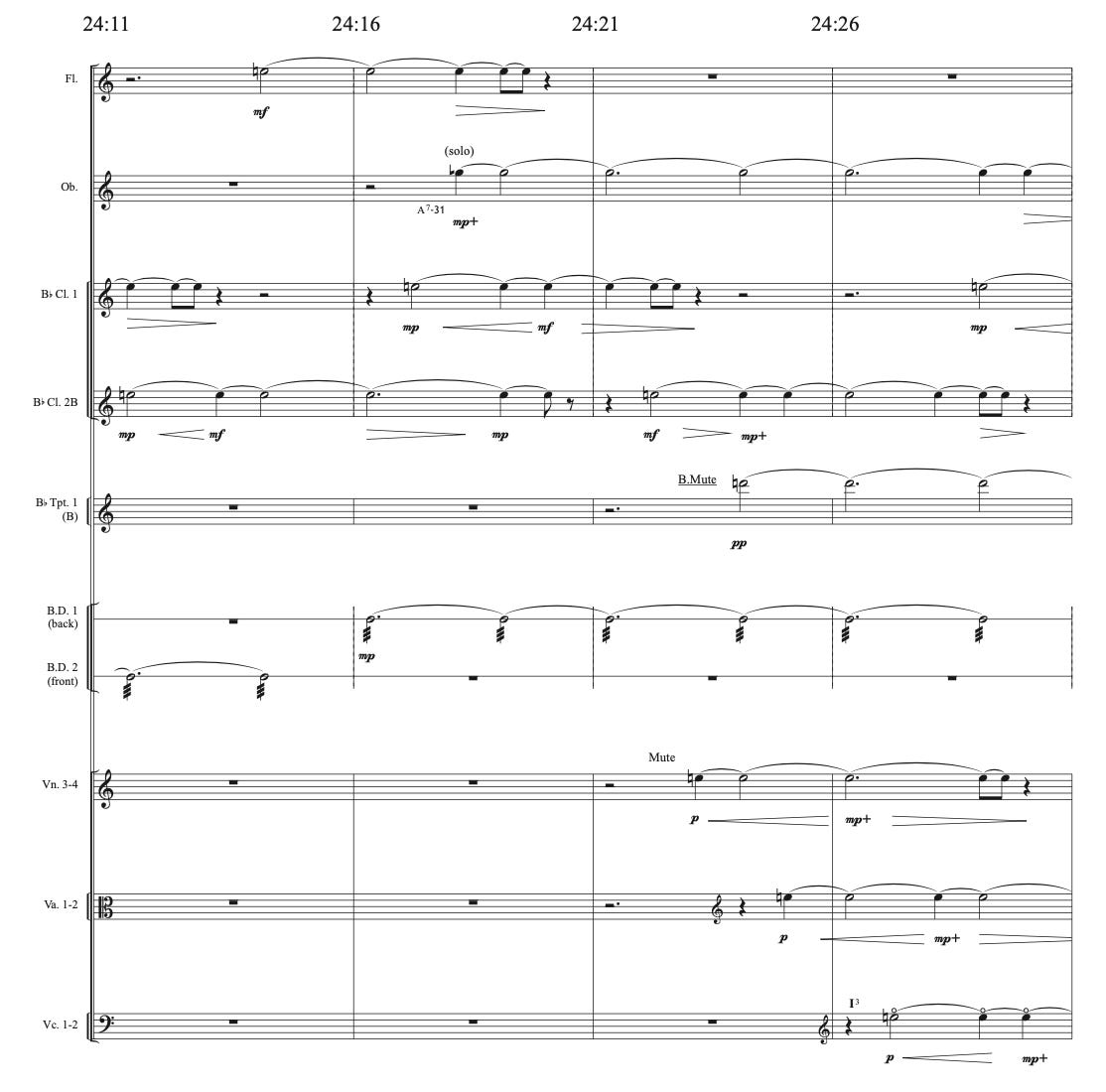
Another key, recurring feature of the Call Mi motif in the section is how it beautifully reinforces the process of sound decay in the reverberant acoustics of the Abbey. To me, its 3-part morphology (attack with piercing high tones in the winds, gradually harmonically ‘decomposed’ and timbrally diffused on the different instruments, and blurred bass drums) feels akin to meta-reverberation: the acoustic emulation of reverberation, in a reverberant space. As a reminder, when digital reverbs are designed, they often follow a similar principle: louder, fast-decaying highs simulate high-frequency damping, while softer, longer low-frequency tails gradually thin the spectrum over time, mimicking air and surface absorption. This process exists naturally in the Abbey, and is mirrored in Chiyoko’s piece, not only in the musical material but also in the spatial placement of instruments. For instance, a pair of the same instruments may play the same tone in succession while positioned at opposite ends of the Abbey, creating a sense of natural decay, diffusion, and spatial interaction. Crazy, complex, interlaced stuff here.
2’30”- 4’30”: expansion in Just intonation and introduction of bass notes
Around 3’30”, Oracle IV undergoes a subtle shift in color, reinforcing the tonal palette through 5-limit F♯ and C♯, stacked in perfect fifths, along with a low D3 on Horn 1. This combination introduces greater melodic tension and lays the groundwork for the ascending melodic motions that unfold in the following minutes.
4’30”-7’41’”: concealed, upward melodic lines
Here is an example of a concealed upward melodic motion. It’s in these moments that one begins to sense how much activity occurs beneath the macro surface of the piece — subtle interactions that can easily go unnoticed on a first listen. You may need to play the excerpt several times to fully catch these intricate layers.
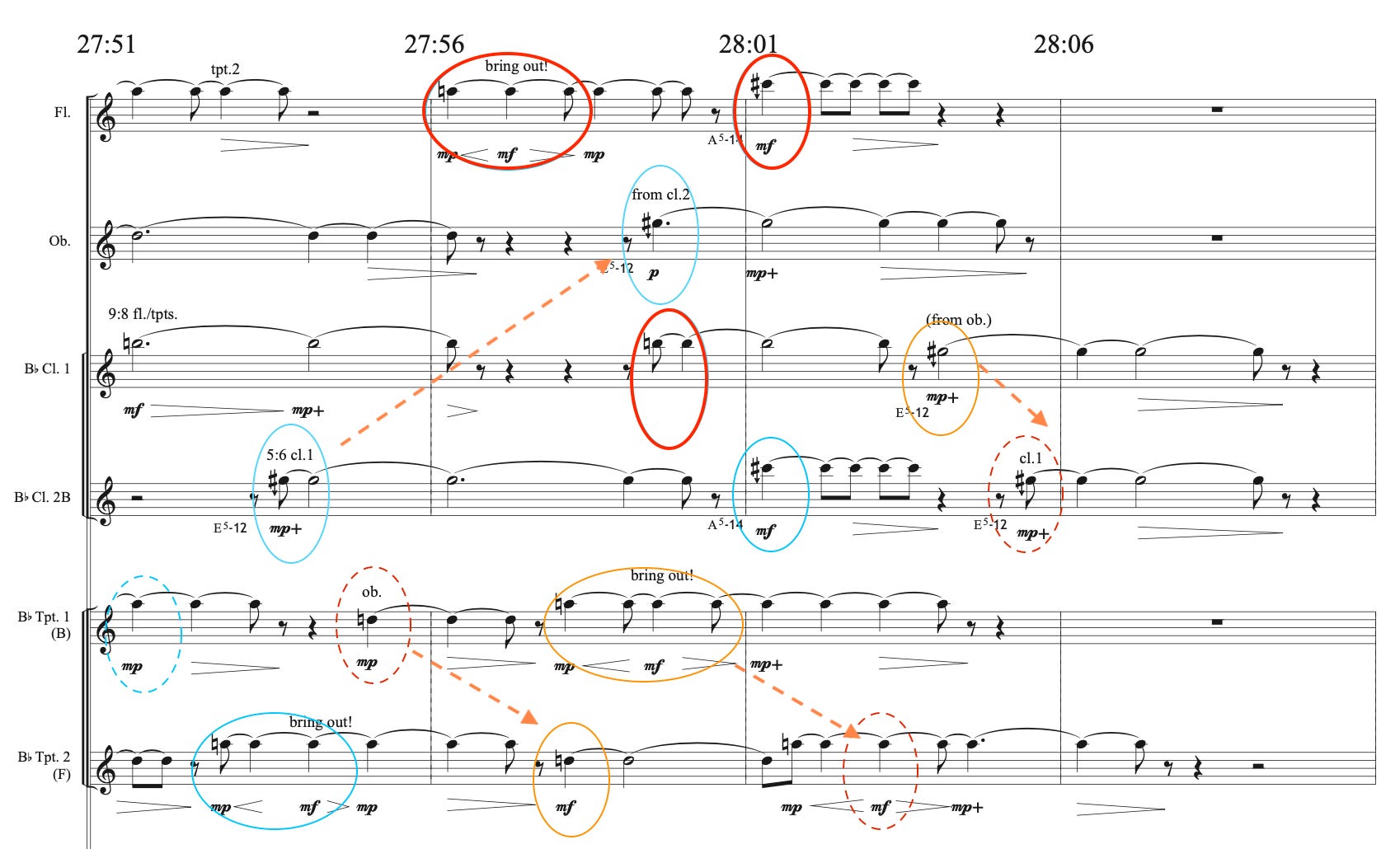
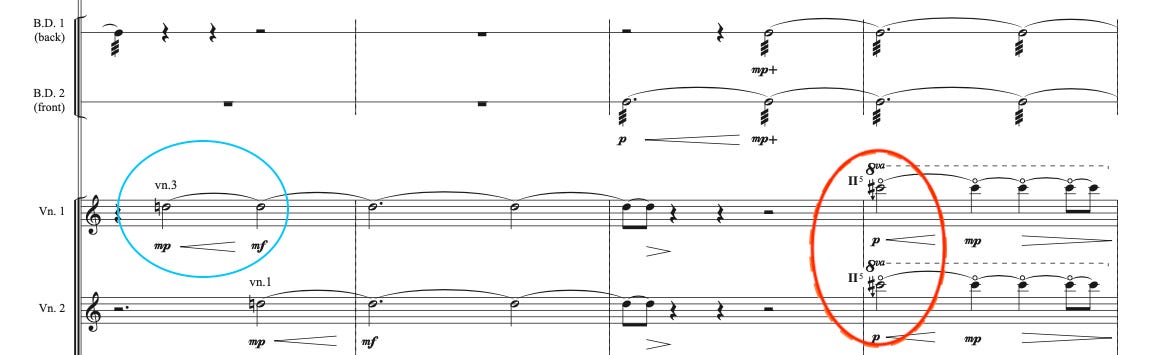
What I want to clumsily emphasize with my circles and arrows is
a) [red circles] the most salient pitches of the section, forming an overall ascending line: G/G♯, B, C♯–14c
b) [blue circles] notes which mostly work in fusion with the others (like D)
c) [orange arrows ] the way one instrument and note lead into another.
Now, imagine the combined effect of a), b), and c), together with the spatial placement of each instrument in the Abbey. Because of the constraints of the recording session, the trajectory of the most salient notes may not fully translate, but in the live performance, they trace the following trajectory:
A on the Flute in the Altar/back section of the Abbey
↓ G# on Clarinet 1 in the middle of the Abbey
↓ G# on Clarinet 2 at the entrance of the Abbey
↑ C#-14c on the Flute in the Altar
↓ high harmonics C# on Vlc 1-2 in the middle of the Abbey
↓ Vln 1-2 in the entrance of the Abbey
↑ bass drums beyond in the very, very back of the altar
Yes, indeed. Just stunning.
7’41”-8’41’”: closing
The final minutes of the piece build tension, occasionally exploring the lower pitch ranges, before gradually thinning out the pitch variety. This creates a refined transition into the minimal musical material of the last, stunning Oracle V. Tadam.
Conclusion: you go grrrl
As usual, much remains unsaid, but we have arrived at the most important point I wanted to make: Chiyoko’s remarkable music seamlessly integrates all musical parameters—harmonic fusion, orchestration, and the choreography of moving sound, without ever compromising its strange, profound beauty. Although highly technical and masterful, the piece is far from a dry acoustic experiment. It’s simply beautiful. So, to nuance my opening question: Chiyoko’s Oracles I-V is one of many examples of how a grrrl making music can feel space, rather than merely taking it.
I want to express my deepest gratitude to Chiyoko for patiently reviewing this post and the previous one, bearing with my occasional cringe, and sharing with us such precious material and music. Thank you too, dear reader, for coming all the way down here.
now, loosen up & play ;D
Lucie
And once again, go check the first post of this series on Chiyoko Szlavnics:
from the Buddhist’s path of transformation, one not only learns to change of form, but eventually surrenders identification with the form altogether, blissing out in the simultaneous perception of emptiness and form. dear reader, let’s face it: we’re not there yet + it is also makes it clear we may learn the most from those who have learned to change form, one way or another
A Survey of Contemporary Music, Cecil Gray, p. 246, 1928 — an excerpt selected by Virginia Wolf in A room of One’s Own.
Adrian Piper, Philosophy en Route to Reality: A Bumpy Ride, Journal of Wolrd Philosophies, Intellectual Journeys/106
[ just in case the extended metaphor wasn’t clear enough ]
The piece was finished in 2020, but underwent two revisions in 2023. One was for a concert in Geneva in May, the other for the recording in October.
+ special mention to 2 amazing composers/musicians: the conductor, Max Murray, who conducted the piece, Thomas Nicholson, who was a tuning expert on site.
From linear notes by Marc Sabat
ofc, from Simone Weil.
Note that the B♭ Clarinet and Trumpet parts are notated as sounding.