
Yano | Natsu
dancer-travelers

Dear reader,
Comment va en ce jour béni des dieux?
After days of pondering a potential topic for my next post, and frankly resisting the temptation to list my 5-favorite-earplugs-of-all-times, inspiration hit. Inspiration—or perhaps old objects/subjects of personal fascination, call it what you will. Either way, the spark of inspiration confirmed a curatorial direction here. The dis ce que series is becoming a quirky yet charming niche where music and art serve mostly as excuses to portray lives well-lived, some of which, at one time or another, were geographically scattered. Boom. And, of course, dis ce que also turns out to be a spot for making dubious jokes with a rather limited vocab and writing skills built on sand.
Speaking of art, sand, and transitional words I don’t have, I thought I would introduce you to two choreographers today: Hideyuki Yano and Natsu Nakajima.
Ôôô my dear music purists, know you are heard and seen. Stick around, you’ll be served, I promise. In fact, this post offers different ways to relate to Yano & Natsu—through their lives, their works, or personal memories of their dance. Perhaps these accumulated perspectives point at the equal flexibility and challenge experienced in writing/speaking about dance. Like Yano said in an interview: “La danse, ça ne s’explique pas”1 —Dance cannot be explained. Mais ouais, allez, on tente. wesh.2
Hideyuki Yano
Hideyuki Yano (矢野英征) was a dancer and choreographer born in 1943 in Japan. He left for the US in the early sixties to study literature, then returned to Tokyo, where he became involved in both the traditional and avant-garde theater scenes of noh and butoh. In 1973, Yano moved to Paris and co-founded a theater-dance-music company group called Mâ Danse Rituel Théâtre together with Elsa Wolliaston. In 1986, Yano became the director of the Besançon-Franche-Comté National Choreographic Center, though only for a brief period. Like many dancers of that time, Yano passed away from AIDS in 1988. But even in death, his body did not remain still or confined to France; it continued to move and travel with the same intentionality it had in life. Indeed, Yano’s ashes were scattered in his birthplace, Tomiaka, and somewhere in the El Oued desert in the South of Algeria. [ can you also hear an unexpected, coincidental link with our last post on Mustapha Skandrani? I couldn’t find any information on Yano’s connection to Algeria, but that’s all fascinating ]
Besides Elsa Wolliaston, Yano’s main collaborators were the dancers/choreographers Karine Saporta, Mark Tompkins, and François Verret. Interestingly, all these artists had non-linear trajectories where contemporary dance was met at a later life stage or in parallel with other professions: photographer, architect, theater performer. Most of them were not of French origin either, thus forming a multi-culti (in the best sense possible) group of independent spirits. Rather than striving to affirm their respective 'identities,' this group, and Yano in particular, sought “ways to go beyond differences, towards the merging of four continents”, aiming to find a sort “of cultural neutrality.”3 This paradigm was not only forward-looking but also miraculous considering France’s tendencies toward ‘entre-soi’.
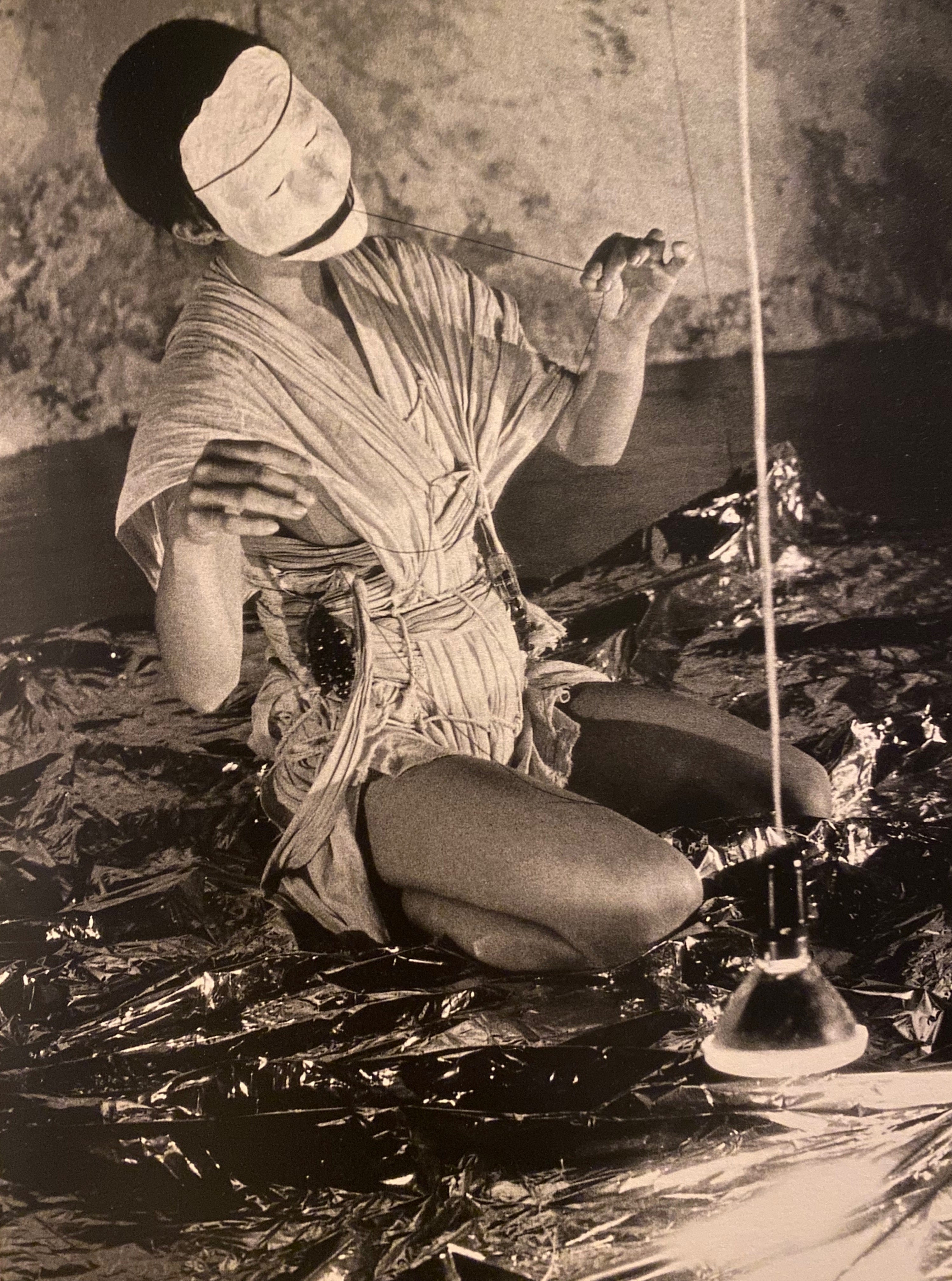
Importantly, Yano was a magnetic teacher for many young artists, as his work explored how the boundaries between dance, theater, and music became irrelevant when viewing the performer's body as a medium for a singular, global expression. Yano’s approach was uncompromising: an intricate back-and-forth movement between spirituality and contemporary consciousness, a traditional rigor and an exemplary freedom where each piece, each performer may be a new field of experimentation. So, for some, Yano was a “non-maître” creating a “non-héritage”4. For others, a smaller minority, Yano could be cruel—which is a plausible hypothesis.
After some online research, it remains unclear whether Yano’s pieces have ever been performed since his passing—a sign that they likely haven’t. His works are also absent from YouTube; only a few are available on Numeridanse. What’s mostly left is one (excellent) book written in French in 2008 by Chantal Aubry5. So yeah, it’s time to revive Yano’s works, while recognizing the fragility of archiving choreographic creations and the humbling reality that there’s no guarantee for the longevity of even the most excellent pieces.
I will focus on one of Yano’s pieces: the 5-minute-long film L’Oubliée.
Remembering L’Oubliée (1982)
[ those who get it get it ]
L’Oubliée is the first piece I’ve encountered from Yano. Apparently, it was performed only a handful of times in studio spaces. I keep returning to it year after year, with the same (if not even deeper) fascination. Find a silent trailer below. The full piece is available on this link [ go watch it ]
© Alain Longuet & Robert Cahen
[ did you watch the piece? sure? alrightoe then ]
For better or for worse, Yano’s research and choreography have been described as 'metaphysical'. I don’t fully buy this ‘metaphysical’ thing but what is certain is that Yano’s work contrasted with the codes of conventional Western contemporary dance: mostly formal, external, and voluntarily energetic. Like butoh or noh, Yano’s research requires a rich inner, introspective quality of energy. Specifically, it feels that the dancer’s ‘inner energy’ can never be pushed, forced or directed, but has to be a complete, steadfast abandonment. Without such energetic qualities, the dancers in L’Oubliée would appear confused, left to their own devices, or grotesque and overly performative. Especially since the piece carries such profound meaning, imaginative power, and potential for interpretation.
To me, as a viewer, L’Oubliée distantly reminds the unfathomable power of death and beauty to engulf everything and everyone. That’s in fact exactly what the main female dancer in L’Oubliée, Karine Sapotra, felt as a performer: “we were like ‘vertiginous containers’ […]”6.
A brief analysis of the piece
I was curious to move beyond the mere symbolism of the piece and my own emotional gaze on it, and instead understand the mechanics at play. So, for your pleasure, and mostly mine, here is a brief analysis of the piece.
First, let’s break down its main components.
Format: It is impossible to truly categorize L’Oubliée. It is undeniably both a film and a movement/theater piece, with music playing an incredibly central role. Achieving such a (successful) blend, deep exploration, and balance between all the mediums involved is quite rare in my opinion. And cool.
Scenography: It could hardly be more minimalist: an empty space, a few white columns, black and white clothing, reminding the gradations of light and shadows in the space.
Movement: From a bird's-eye view, there’s almost nothing: a collective march, some changes in facial expressions, one central dance sequence with arms ornamentations recalling baroque dance, bodies laying on the floor, & basta cosi
Music: alright, I have more to say about it. The piece is based on excerpts of a 1967 recording of François Couperin’s Leçons des Ténèbres interpreted by Alfred Deller and Philip Todd. It’s so, so beautiful, we might as well listen to the original recording:
The excerpts used in the first 4 minutes of L’Oubliée are based on the opening of the Leçon [0’00”-2’45”], manipulated very lightly, carefully and transparently: slight changes of speed, abrupt but mastered cuts/jumps from one section of the Leçon to another, superimposing of excerpts. Overall, added to the ‘antiquated’ quality of Couperin’s recording and its interpretation, all these subtle manipulations of in the soundtrack are very effective and emphasize some flash-backs kinds of sensations.
But truly, the piece’s magic (i.e. its implicit symbolism) happens when examining the symbiosis between all its elements: the music, spatial arrangement of the dancers, their movements, etc. So, moving to a more detailed but not exhaustive analysis:
Introduction [0’00” - 0’53”] :
The opening of Leçon is heard slightly sped up. The space is empty, the 4 dancers appear with neutral facial expressions, wrapped with white shroud-like fabrics. They start walking. The scene resembles a funeral march, reinforced by the ghost-like sped-up voices from the Leçon.
There is a prolonged silence, like a suspension,, followed by a cut to a shot of the space completely empty.
Section 1 [0’53” - 3’00”] : Leçon’s opening is played at normal speed. One dancer enters the space, followed by the others. The shot zooms in on the dancers' shadows, pausing on the face of one (resembling a priest) and on a female dancer, Karine Saporta. As the dancers slowly march through the space, the dominant movement in the scene is not their actions, but the shadows in the background, seemingly swaying like waves.
Section 2 [3’00”-3’50”] :
[ 3’00” - 3’21” ] : As Leçon begins its duo of descending, melodic, and ornamented lines, Karine is shown in black, collapsing to the floor on her side with wide-open eyes and mouth—an agonizing expression that evokes despair, abjection, or horror. Her fall is replayed once; and in a split second, we see her lying down. A similar sequence follows with Yano [3’06”]: first, a zoom on his head gently falling back, his mouth open, exuding softness and sensuality, mirrored by the delicate undressing of his black and white clothing, revealing his bare skin. Another abrupt cut then zooms closely on Yano’s hand, and his body lying on the ground — wearing black, his face discreetly turned away.
[ 3’21” - 3’50”] : Here comes a much slower, ornamented, delicate fall from Karine, capturing her full body, as well as 2 dancers standing behind her. Her face is neutral, she is like suspended, bending from her side with her head tilted back, her thick, dense chevelure leading the way to the ground, her arms falling like branches of a tree lightly caressed by the wind — this is an incredible scene. At 3’33”, we’re back on a closer shot on Yano, his neck and upper body back softly arched. This time, one may notice a shadow brushing his skin as his cloth slowly falls from his chest again as he straightens back. In the same sequencing as before: the camera abruptly switches to Yano lying on the floor, brushing slowly parts of his body and transitioning to the last part of the piece:
Section 3 [3’50” - end] :
L’Oubliée jumps to another section of Leçon [4'47-5’17”], combined with an almost hallucinated, very distant superimposing of another section of the piece. The film switches to Karine laying on the ground, a revulsed expression on her face, while a third dancer caringly examines her body, as if checking if she is dead. The same ‘caring’ dancer then carries Yano’s inert body: his legs first, his hands next. Another shadow takes much space in the scene [4’09”].
4’13” : Karine wears white again, she’s standing next to the ‘caring’ dancer who now has a strange, content, crooked smile.
4’26” : The ‘caring’ dancer stands next to the ‘priest’. The soundtrack has jumped to yet another section of the Leçon [6’52”- until its conclusive phrase at 7’53” in its original recording], with another faded and light superimposing of the final section of the piece [12’27” - end]. In addition, there is a panning effect: the foregrounded excerpt of Leçon goes to the left, and the second superimposed excerpt softly emerges from the right, giving an impression of a widening of the space until the end of the piece. In the meantime:
4’35” : Evoking the beginning of the piece, the 4 dancers stand next to each other in line, all wearing white, with these rocking shadows behind them.
4’44” : Wearing black, Karine is curled up on the floor, caressing it, in a warmer light. She’s looks innocent, like a child. Then the film switches to Yano’s face, his simple, far-reaching gaze. He also looks like a child as he softly embraces his white, dense fabric, a bit like a comfort blanket. This scene is soft, peaceful, tender.
5’00” : Zooming back on the whole space, the 4 dancers face each other in a square. We mostly see their backs, the light is much more deemer.
5’05” : Cut to the empty and even darker space, with the rocking shadows encountered at the beginning of the piece, and one fixed shadow of a person. For a second, we catch a glimpse of the entrance of a white figure in the space. And that’s the end of the piece: an impression of ‘déjà-vu’. In fact, this last scene is actually a repetition of the end its introduction.
My conclusion is : GOOD LORD, his piece is decisively smart. Through its mix of visual/sound cuts and loops, it feels as though it has no true beginning or end—only a collection of delicately crafted messages and fleeting images, ad infinitum.
From Yano to Natsu Nakajumi
When asked if he had one message to convey as a creator, Yano answered “perhaps the journey: […] the curiosity that drives one to travel, and the inner journey.”7 And among the texts written by Yano that I’ve read, one has remained with me inexplicably over the years. Here it is, in its original, impeccable French:
Le retour à Istanbul de Bandırma en bateau. […]. Il y avait un garçon de 3-4 ans qui hurlait dans les bras de sa mère au moment où le bateau partait et où son grand-père, qui est venu les accompagner pour dire au revoir, quittait le bateau. L’enfant ne supportait pas que le bateau quitte la terre (cela lui faisait peur, peut-être), la distance entre la terre et lui augmentant (bien sûr, la distance entre son grand-père et lui-même aussi).
— The return to Istanbul from Bandırma by boat. […]. There was a 3-4-year-old boy screaming in his mother’s arms as the boat departed and his grandfather, who had come to see them off, was leaving the boat. The child couldn’t bear the boat leaving the shore (perhaps it frightened him), the increasing distance between the land and himself (and, of course, the distance between his grandfather and himself as well).
I’m not sure why, but this description evokes in my (admittedly vivid) imagination a kind of Noah’s Ark setting sail from the shores. The mother’s arms blend with the boy’s, which soar upwards towards his grandfather, forming an arch between the mother, the boy, and the old man, with water in between. Somehow, more than his dance, those specific words by Yano remind me of Natsu Nakajima’s trajectory.
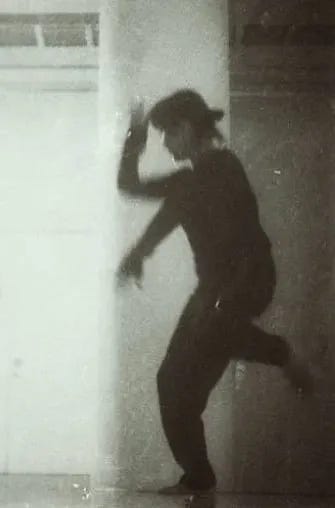
Natsu (yes, I feel like calling her by her first name) was a Japanese butoh dancer and an exact contemporary of Yano, born in 1943, just like him. And like Yano, Natsu developed a fearless relationship to death and a disciplined freedom in her dance, qualities likely inherited from her primary teacher and collaborator, Tatsumi Hijikata. She considered that “butoh rejects any notion of symbolism, message, or formalism, and only express its energy and freedom. It is not art that I aspire to, but love.” For that last reason, she was an awesome teacher, one who included everybody in her classes and could make every-body move. Last year, at the age of 81, after postponing the trip for years, Natsu finally went to Mexico, a place that felt like a second home to her. Shortly after her arrival, Natsu passed away. I can’t help but notice how her dispersed departure somehow echoes Yano’s.
I had the chance to meet Natsu in the Hague in 2017 during a workshop in a local dance studio. She had an extraordinary strength, lightness and remarkable precision. [spoiler & nervous lol: I promise this is the last ‘departure’ I’ll mention in this post] In the last day of our workshop together, Natsu learned the passing of one of her dance colleagues and friend. Butoh being butoh, of course, Natsu decided to dance for him. Here are my notes from her piece.
Emerging from a foggy kind of music, Natsu appeared in the studio with her face covered in white pain, wearing simple, black clothes enhancing her graceful bearing, her eyes blinking. She looks like a kid. She begins to push an empty, rolling chair, ‘dressed’ with a few pieces of fabrics and two rocks placed on top of them. Natsu opens the studio curtains, showing the chair/ghost the Hague’s grey sky through the window (she smiles). She pushes the chair further until it reaches the mirror, gently showing it its empty reflection.
As she returns to the center of the studio from the mirror, the music is no longer heard, and Natsu no longer smiles as if the chair/ghost had become a burden. Delicately, she stops pushing the chair, adjusts the ghost’s clothes, and takes the stones in her hand.
( A long moment of silence and stillness )
Natsu strikes the stones together, loudly, in several directions, before walking to a small pile of sand or ashes placed on the ground. She softly rubs the ashes on her upper chest and neck. She touches the ashes with her hands, caresses them, forms another pile. In her small hands, she takes two handfuls of ashes and carefully stands up. Her walk is slow, as if moving through thick air, while some ashes fall lightly from her hands, as if by accident. When she reaches the center of the space, Natsu stiffens and rises onto the tips of her toes. She raises one arm and lets the ashes fall to the ground in complete silence. She then raises her other arms, the ashes continuing to fall. She repeats the gesture in several directions, until she faces us. Slowly, as the Adagietto from Malher’s 5th Symphony lightly plays in the background, Natu sits down, and even more slowly lies down until the recording ends.
When she stands up, no one speaks nor move. She simply brushes herself off and moves on.8
What surprises me in those notes is that although they don’t give much detail of the piece, the simple description they offer feels, in itself, deeply evocative and moving. And mysterious. Those qualities inherent in Natsu’s craft and gift. Please enjoy a recording below of her in action
..and cut. I’ll stop there, not knowing where I ended up — maybe somewhere between sand and ashes. At least, this was a small contribution to keeping Yano’s and Natsu’s pieces known and seen, with a subtle invitation for those of us inspired by their work to share it further. And, dear reader, here’s another invitation to you: you’re warmly welcome to share your secret shelters & treasured pieces here. Rest assured, they will be cherished.
Take good care,
Lucie
ps: i might not be able to post in 2 weeks, but i’ll be back soon. . .
See this very cool interview: https://www.ina.fr/ina-eclaire-actu/video/r21189691/interview-du-choregraphe-hideyuki-yano
I’m sorry I can’t help it
Sidonie Rochon. Dancer and choreographer, founding member of Mâ dance company.
François Verret, quoted in Chantal Aubry’s book, see reference below.
Chantal Aubry, Yano, un artiste japonais à Paris, Centre national de la danse, 2008.
Same reference as above.
“… Le voyage dans les deux sens: la curiosité qui pousse au voyage, et aussi le voyage intérieur”. See reference of the INA interview on note 1.
This description is the one I had written back in 2017.